
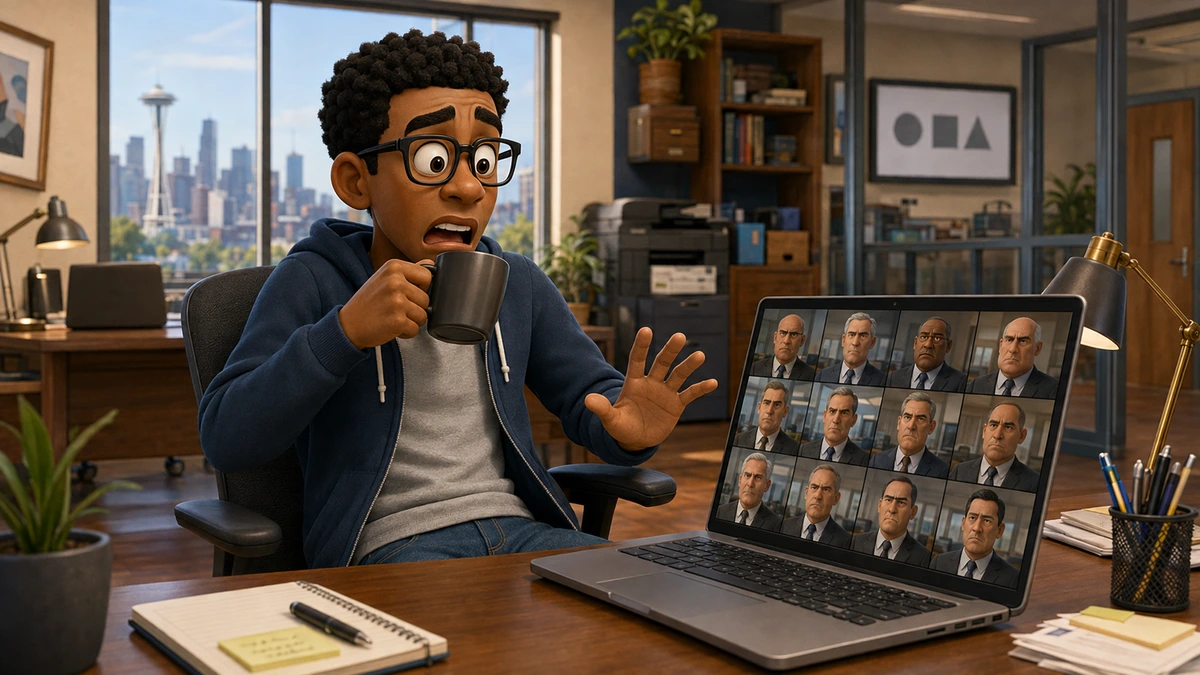
At 9:02 on Monday morning, Alex joined a Zoom meeting and immediately realized he had made a terrible mistake.
He had expected the weekly Immigraships Creative Catch-up—a relaxed meeting where John discussed new ideas, Maya organized the week, Olivia asked sensible questions, and Ethan attempted to look as though he had not stayed awake until two in the morning.
Instead, Alex found twelve strangers wearing serious gray suits.
Nobody was smiling.
A spreadsheet filled the shared screen. One column was labeled Structural Damage, another was labeled Projected Infestation Growth, and a bright red section in the corner simply said DANGER ZONE.
Alex froze with his coffee halfway to his mouth.
The meeting title at the top of the window read:
FINAL REGIONAL REVIEW
That was not helpful.
The speaker, an older man seated in front of an intimidating wall of business books, stopped in the middle of a sentence.
“And that brings us to the projected third-quarter containment strate—”
He leaned toward his camera.
“Excuse me. Who just joined?”
Twelve faces turned toward Alex’s square.
This was the moment when a reasonable person would apologize and leave.
Alex was usually a reasonable person. As the office manager at Immigraships, he solved scheduling problems, remembered passwords, rescued malfunctioning printers, and prevented small administrative mistakes from becoming full-scale emergencies.
Unfortunately, none of those abilities survived direct exposure to twelve confused executives.
Instead of leaving, Alex smiled, lifted one hand, and gave the group a confident little wave.
That wave changed everything.
Here are the eleven awkward moments that followed after Alex joined the wrong Zoom meeting—and decided pretending he belonged was somehow safer than admitting the truth.
Table of Contents
1. The Zoom Entrance That Made His Soul Leave His Body
The Zoom arrival chime sounded unusually loud.
BING-BONG!
To Alex, it did not sound like a notification. It sounded like a courtroom official announcing the arrival of the defendant.
Every stranger on the screen stared at him. Their expressions ranged from mild confusion to the kind of suspicion normally reserved for someone carrying an unmarked suitcase through an airport.
Alex quickly studied his own camera preview.
He was wearing a yellow T-shirt because he had planned to put on a jacket before the real meeting began. The jacket was still hanging over the back of his chair. His hair suggested that a pillow had recently won an argument with it. Behind him, a stack of unopened office supplies leaned dangerously beside a filing cabinet.
He did not look like a regional executive.
He looked like the person a regional executive might call when the Wi-Fi stopped working.
“Are you with the Seattle office?” the speaker asked.
Alex’s brain received the question, placed it in an emergency folder, and refused to process it.
He smiled more widely.
Then he nodded.
It was a tiny movement, but it carried enormous legal and emotional consequences. He had just confirmed an identity he did not possess for a company he could not name.
“Excellent,” the man said. “We were expecting regional input.”
Alex’s inner voice screamed.
His outer face remained professionally calm.
He had been in the wrong meeting for twelve seconds, and somehow he already had regional responsibilities.
2. The Aggressive Nod That Accidentally Established Expertise
The presentation resumed.
The speaker began discussing “integrated pest-mitigation outcomes,” “seasonal colony migration,” and “synergistic containment resources.”
Alex understood each individual word.
Together, they became soup.
He knew he needed to appear attentive, so he deployed one of the most dangerous tools in professional communication: the serious nod.
This was not a casual movement. Alex nodded slowly, thoughtfully, and with the expression of a man evaluating information of international importance.
When the graph rose, he frowned.
When the graph fell, he narrowed his eyes.
When somebody mentioned “unacceptable moisture penetration,” he wrote something on a notepad to suggest that moisture penetration had been one of his principal concerns for years.
The note said:
WHAT COMPANY IS THIS?
Unfortunately, his performance was too convincing.
A woman named Denise noticed him nodding and said, “It looks as though Seattle agrees.”
Several attendees turned toward Alex.
He nodded again because nodding was now the only language he spoke.
“Good,” Denise said. “That supports the revised treatment model.”
Alex had no idea what he had supported. It could have been a new budget, a chemical strategy, or an organized military response against termites.
Still, he had learned an important lesson: if you nod with enough confidence in the wrong Zoom meeting, people will not assume you are confused.
They will assume you are an expert.
Then they will give you work.
3. The Desperate Search for One Useful Clue
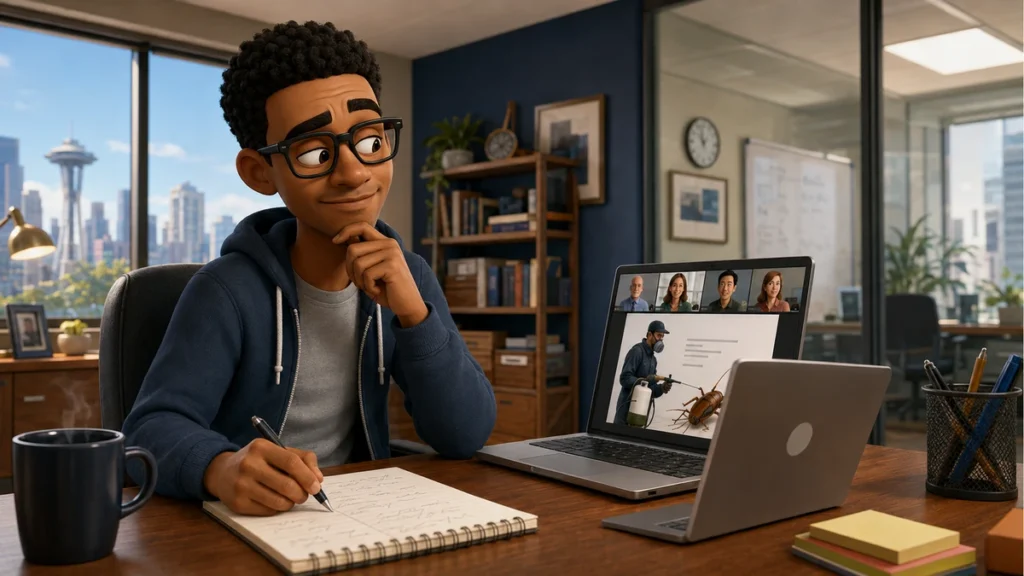
While his head continued nodding automatically, Alex began searching the Zoom screen for evidence.
He examined display names.
Denise—Regional Operations
Martin—Field Services
Carla—Compliance
Greg—Sector 4
Sector 4 sounded alarming. Anything divided into numbered sectors was either extremely corporate or about to appear in a science-fiction film.
Alex looked at the shared spreadsheet again.
The company logo was hidden behind a notification. The presentation title had been shortened to Q3_FINAL_v8_REALLYFINAL2, proving that even mysterious corporations suffered from poor file management.
Then he saw several useful words:
Agriculture.
Crop loss.
Beetle activity.
Alex leaned toward the screen until his face nearly filled his entire camera square.
A beetle infestation.
He had accidentally entered a regional meeting for an agricultural pest-control company.
This discovery answered one question and created approximately forty more.
Why had he received the invitation? Why did they expect someone from Seattle? Who was supposed to attend? And why was Sector 4 losing a battle against beetles?
Alex opened his calendar without leaving the Zoom window. Two meetings had started at 9:00. One was the Immigraships Creative Catch-up. The other was an invitation forwarded by a building-services contractor concerning a completely unrelated vendor review.
He had clicked the wrong link.
The answer was now obvious.
The exit button was also obvious.
Yet Alex stayed.
At this point, leaving felt less like correcting a mistake and more like abandoning a position during an active beetle emergency.
4. The “You’re on Mute” Gambit
Disaster arrived at 9:11.
The older speaker looked directly into the camera.
“Alex, we haven’t heard from Seattle yet. What is your assessment of the infestation in Sector 4?”
Alex stopped breathing.
He was not qualified to assess Sector 4.
He was barely qualified to identify four common insects, and one of those was “the flying thing near the lamp.”
Everyone waited.
Fortunately, years of remote work had taught Alex one universal truth: microphone problems are the emergency exits of digital communication.
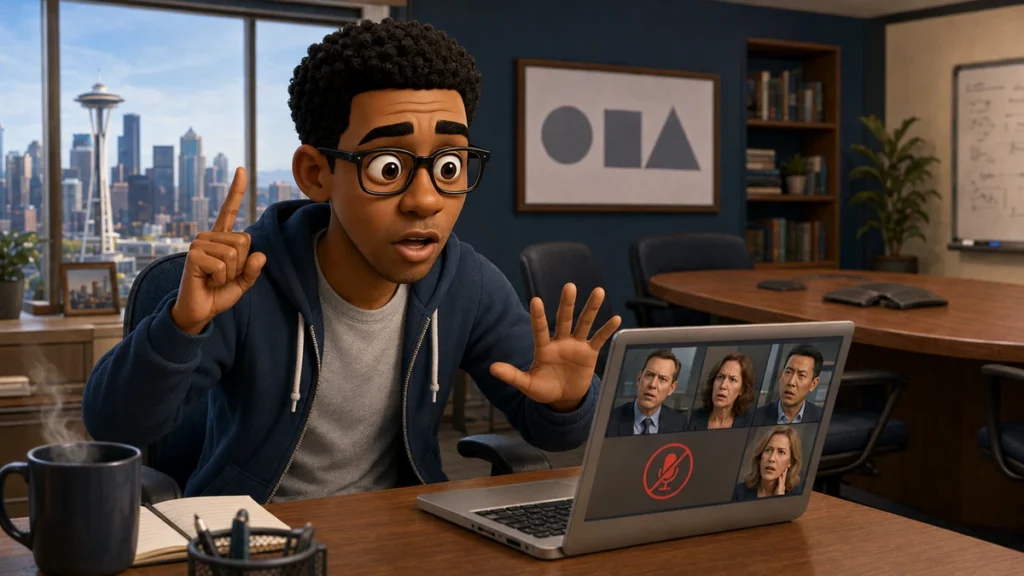
He began moving his mouth while keeping himself muted.
He gestured toward the presentation. He raised one finger to emphasize an imaginary point. He briefly leaned back as though describing the wider strategic consequences of beetle migration.
It was the finest speech he had never delivered.
After ten seconds, Denise interrupted.
“Alex, I think you’re muted.”
He widened his eyes and pointed at the microphone icon as if seeing it for the first time.
Then he clicked it several times without unmuting.
“Still nothing,” Martin said.
Alex shook his head with the exhausted disappointment of a professional betrayed by technology. He typed quickly in the chat:
Audio-driver problem. Restarting now. Please continue without me.
The older man nodded sympathetically.
“No problem. Add your assessment to the follow-up report.”
Alex’s relief lasted less than one second.
He had escaped a question by accidentally accepting a report assignment.
The wrong Zoom meeting was no longer merely embarrassing.
It now had deliverables.
5. The Random Applause That Continued Too Long
At 9:18, the atmosphere suddenly changed.
Denise finished explaining a complicated yield projection and smiled.
“Based on these results, the western region could see a fifteen-percent improvement.”
One attendee began clapping.
Then another joined.
Alex had been secretly messaging Ethan under his desk:
Tell John I’m having technical problems.
Ethan replied:
You are literally online. We can see you in another meeting.
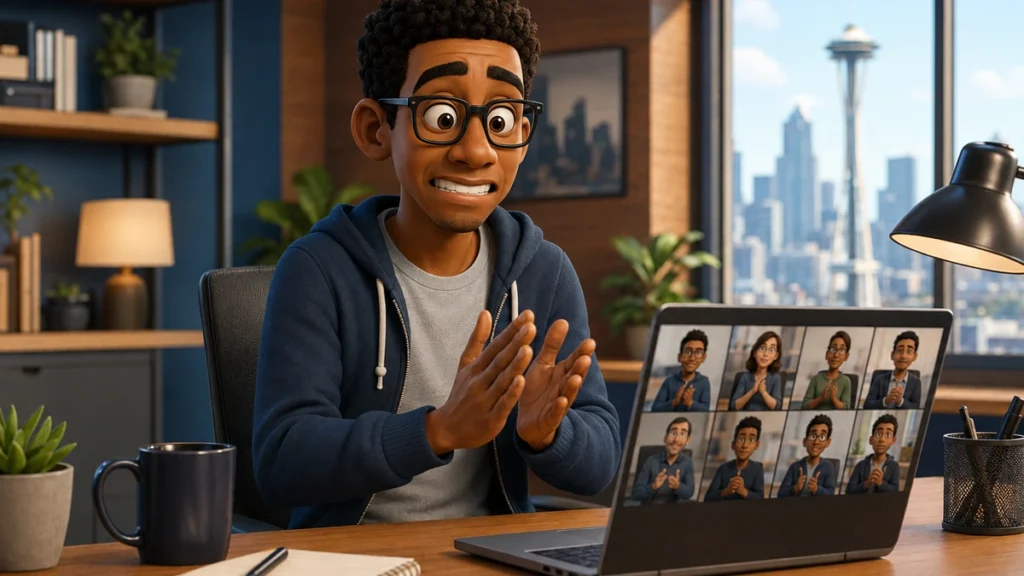
When Alex looked up, everyone was applauding.
He did not know what had happened, but refusing to clap might expose him as someone who opposed regional improvement.
So Alex applauded.
Enthusiastically.
He smiled with extraordinary pride, as though he had personally negotiated peace between the farmers and the beetles. He nodded at Denise. He even raised his hands slightly higher so his appreciation would be clearly visible.
Then the others stopped.
Alex did not.
For three long claps, he was the only person still celebrating.
CLAP. CLAP. CLAP.
The sound echoed through his microphone because, during the confusion, he had accidentally unmuted himself.
Everyone watched.
Alex slowly lowered his hands and converted the final clap into an awkward examination of his wrist.
“Excellent work,” he said quietly.
Nobody responded.
The presentation resumed.
Alex muted himself and wrote a new note:
APPLAUSE HAS AN ENDING. FIND IT.
6. The Corporate Acronym Ambush
Every workplace develops its own collection of acronyms. Immigraships had several, although Alex privately believed most of them existed because people enjoyed making simple ideas sound expensive.
This company operated on another level.
“We’ll need the revised B.E.E.T.L.E. framework aligned with P.E.S.T. before the R.O.A.C.H. review,” Martin explained.
Alex stared at the screen.
Nobody laughed.
Apparently, these were real business terms.
He opened a fresh page in his notebook and copied each acronym carefully:
B.E.E.T.L.E.
P.E.S.T.
R.O.A.C.H.
The meeting had become indistinguishable from a comedy sketch written by an exterminator.
“What are you using in Seattle?” Carla asked.
Alex felt his pulse accelerate.
His fake audio failure could not protect him from every question. He needed an answer that sounded meaningful without containing any verifiable information.
He unmuted himself.
“We’re taking a more… adaptive approach.”
The group waited.
Alex continued.
“We don’t want the framework controlling the response. We want the response informing the framework.”
Silence.
He had assembled the sentence entirely from professional-sounding words and hope.
Then Martin nodded.
“That’s exactly what I’ve been saying.”
Carla wrote it down.
Alex muted himself before his accidental philosophy could produce another assignment.
He had discovered the most frightening rule of corporate jargon: if a sentence is vague enough, someone may consider it brilliant.
7. The Coffee Slurp Heard Across the Region
By 9:25, Alex desperately needed coffee.
Pretending to be an agricultural strategy consultant required more energy than managing the actual Immigraships office.
He checked his microphone icon.
Muted.
Good.
He lifted his mug and took a long drink.
SLUUURP.
The noise exploded through the meeting.
Alex looked at the microphone icon again.
Not muted.
He had forgotten that he had unmuted himself during the acronym discussion.
On camera, the mug covered most of his face. From the other attendees’ perspective, Seattle’s mysterious regional expert had temporarily transformed into a giant ceramic container producing drainage sounds.
The speaker stopped.
“Was that a question?” he asked.
Alex lowered the mug.
A small line of coffee had escaped onto his shirt.
“No,” Alex said. “Just confirming fluid movement.”
He had no idea why he said it.
Perhaps the word “fluid” had survived from an earlier slide. Perhaps panic had temporarily taken control of his vocabulary.
Martin nodded again.
“Right. Drainage remains a concern.”
The presentation continued as though Alex’s coffee had contributed to the analysis.
Alex set the mug far beyond arm’s reach.
He had entered the Zoom meeting without knowing the company’s name, yet his drinking technique was now part of the official conversation.
8. The Background Interruption From the Real Meeting
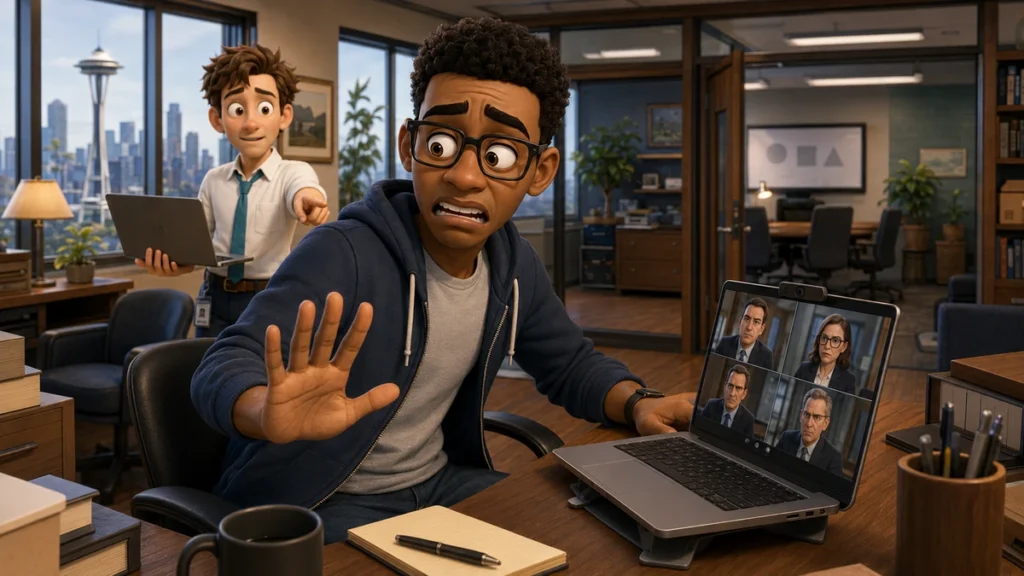
Alex had survived nearly thirty minutes when the door behind him opened.
Ethan stepped into the room holding his laptop.
Because Alex was working from a small side office at L-009, the entire Immigraships team knew exactly where he was. They had spent the morning watching his name remain trapped inside another Zoom meeting while their real Creative Catch-up sat unfinished.
Ethan appeared over Alex’s shoulder.
“John wants to know why you’re in a meeting called Regional Beetle Containment.”
Alex’s eyes widened.
He made a frantic cutting motion with one hand.
Ethan looked at the screen.
“Are those the beetle people?”
Every attendee heard him.
The twelve strangers stared at Alex.
This was the moment the entire performance should have collapsed.
Instead, Alex turned slightly toward the camera and smiled.
“That’s Ethan,” he said. “He represents our emerging workforce perspective.”
Ethan frowned.
“I’m the intern.”
“Exactly,” Alex replied. “Emerging.”
The older speaker seemed impressed.
“Good initiative, bringing junior staff into strategic discussions.”
Ethan opened his mouth.
Alex pointed firmly toward the door with the authority of an office manager defending the last remains of his dignity.
Ethan left, but not before giving the camera a cheerful wave.
Seconds later, Alex received a message from John:
End the meeting.
Then another arrived from Maya:
No, wait. We want to see how this ends.
9. The Fake Frozen-Screen Performance
At 9:34, the group returned to Sector 4.
“Alex,” Denise said, “can you confirm Seattle’s proposed budget allocation?”
Alex had exhausted his available strategies.
He could not blame his microphone again. He could not answer with another meaningless framework sentence. He could not take another drink and pretend it concerned drainage.
Only one option remained.
The frozen-screen performance.
Alex stopped moving.
He held his face in a neutral expression and stared at a point just above the camera. His back began to ache immediately, but he remained perfectly still.
“Alex?” Denise asked.
He did not blink.
“I think we lost him,” Martin said.
Alex’s left eye began to water.
The meeting continued.
After several seconds, he shifted into a different position and froze again, hoping the movement would resemble a connection jump.
Unfortunately, Carla noticed.
“His picture changed.”
Alex froze with one hand halfway toward his face.
“Unstable bandwidth,” Martin concluded.
Alex stayed motionless while a message appeared from Olivia:
We are watching your performance from the conference room. Ethan says you blinked.
Alex ignored it.
Another message arrived:
Maya gives the first freeze 7/10. The second pose lacks realism.
Being evaluated by his real coworkers while deceiving imaginary coworkers introduced an entirely new level of humiliation.
Still, the strategy worked.
The budget discussion moved forward without Seattle.
10. The Enthusiastic Vote Against Everyone’s Bonus
The meeting finally approached its conclusion.
Alex had survived long enough to believe he might escape without causing measurable damage.
Then the older speaker asked one final question.
“Are we agreed that the holiday bonus reserve should be redirected toward emergency fumigation?”
Alex had stopped listening. He was reading a message from John:
Your real meeting has now become a watch party.
Alex heard the speaker’s rising tone and assumed the group wanted ordinary confirmation.
He gave the camera a large thumbs-up.
“Absolutely,” he said. “One hundred percent.”
The reaction was immediate.
Denise’s smile disappeared.
Martin looked down.
Carla slowly removed her glasses.
Somebody whispered, “Seriously?”
Alex replayed the question in his mind.
Holiday bonus.
Redirected.
Emergency fumigation.
He had enthusiastically volunteered everyone else’s bonus money to fight beetles.
His thumb remained raised beside his face like evidence in a trial.
Alex slowly lowered it and scratched his nose, attempting to suggest that no vote had occurred.
“Well,” the older man said, “Seattle clearly feels strongly.”
“No,” Alex replied. “Seattle believes in… balanced recognition.”
It was too late.
His vote had entered the meeting minutes.
Somewhere in an organization he did not work for, an unknown person from Seattle had become the public face of anti-bonus policy.
Alex finally understood that remaining silent would have been more professional.
Leaving forty minutes earlier would have been better still.
11. The Great Zoom Escape—and the Final Humiliation
At 9:47, the speaker finally said the most beautiful words Alex had ever heard.
“Thank you, everyone. Let’s wrap up.”
The attendees performed the traditional Zoom farewell: small smiles, awkward waves, and several people speaking at once.
“Thanks.”
“Take care.”
“See you Thursday.”
“Good input, Seattle.”
Alex waved with both hands. He had entered the meeting as an unidentified stranger and was leaving as a regional consultant with strong opinions about frameworks, drainage, and employee compensation.
He moved his cursor toward the red button.
Before he could click, Denise spoke.
“Alex, please stay behind for one moment.”
His hand stopped.
The other attendees disappeared one by one until only Alex and Denise remained.
She leaned toward her camera.
“You aren’t Daniel from the Seattle agricultural office, are you?”
Alex’s entire performance collapsed.
“No,” he admitted. “I manage an office called Immigraships. I clicked the wrong Zoom link.”
Denise stared at him.
Then she began laughing.
Not a polite laugh. A full, helpless laugh that forced her to turn away from the camera.
“I knew it,” she said. “Daniel is sixty-three.”
Alex looked down at his yellow T-shirt.
“That explains some of the confusion.”
“For what it’s worth,” Denise added, “your framework comment was better than anything in the presentation.”
She promised to remove his holiday-bonus vote from the record and allowed him to leave with what remained of his dignity.
Alex clicked Leave Meeting.
His screen returned to the desktop.
Silence.
Then his phone buzzed.
John had sent one final message:
Creative Catch-up ended fifteen minutes ago. Please prepare a regional beetle report by noon.
Alex looked through the glass wall toward the conference room.
John, Maya, Olivia, and Ethan were applauding.
This time, Alex knew exactly when not to join in.
Why Wrong Zoom Meetings Are So Awkward
Wrong Zoom meetings are funny because they combine two ordinary fears: entering the wrong room and being noticed immediately.
In a physical office, you can open the wrong door, apologize, and step backward. On Zoom, your face appears in a grid, your name arrives with a chime, and twelve strangers receive several seconds to study your panic in high definition.
Technology also creates the dangerous illusion that we can hide our mistakes. We mute ourselves, turn off cameras, blame unstable internet, and hope nobody asks a direct question. These tools may delay embarrassment, but they rarely eliminate it.
Alex’s mistake became much worse because he kept trying to protect himself from one simple sentence:
“Sorry, I joined the wrong meeting.”
That sentence would have ended the problem immediately.
Instead, he invented audio trouble, adopted a regional identity, delivered strategic advice, performed a fake connection freeze, and nearly eliminated the holiday bonuses of people he had never met.
Sometimes pretending to belong is more frightening than admitting you do not.
It is also significantly more work.
How to Avoid Joining the Wrong Meeting on Zoom
You do not need Alex’s experience to learn a few useful lessons.
Before clicking a Zoom link, check the meeting title, organizer, and calendar description. When two appointments begin at the same time, confirm which invitation belongs to your team. Updating your display name can also prevent you from arriving in an executive meeting under an unfortunate username created years earlier.
If you do enter the wrong meeting, do not wave, nod, vote, or accept responsibility for a numbered sector.
Simply say:
“Sorry, I have the wrong link.”
Then leave.
Most people will understand. Remote workers have seen frozen cameras, accidental filters, mysterious background noises, unmuted conversations, and colleagues who spend five minutes presenting the wrong screen. A mistaken click is rarely memorable.
Pretending to be a beetle-containment strategist for forty-five minutes is memorable.
That becomes office history.
The Real Lesson From Alex’s Zoom Disaster
Alex’s morning began with one wrong click and continued through eleven increasingly avoidable moments of professional panic.
He entered the wrong Zoom meeting.
He pretended to understand pest-control jargon.
He applauded a yield projection.
He contributed to a drainage discussion with a coffee slurp.
He introduced Ethan as the voice of an emerging workforce.
He faked a frozen connection badly enough to receive live performance reviews from his actual colleagues.
Finally, he voted against holiday bonuses and had to confess everything to Denise.
The lesson is simple: mistakes become larger when pride prevents us from correcting them.
Most awkward situations have a small exit available near the beginning. Use it.
Check the invitation. Read the meeting title. Keep your microphone muted while drinking coffee. And if twelve strangers begin discussing beetles when you expected a creative meeting, trust your instincts.
You do not belong there.
Leave before they assign you Sector 4.
Your Turn
Have you ever joined the wrong Zoom meeting, online class, interview, or virtual event?
Did you leave immediately—or stay long enough for somebody to ask your opinion?
Share your funniest online-meeting mistake in the comments, and send this story to the coworker who always has seventeen calendar tabs open.
Then subscribe to the Immigraships newsletter for more original comic stories about office life, everyday mistakes, and ordinary people making questionable decisions with extraordinary confidence.